
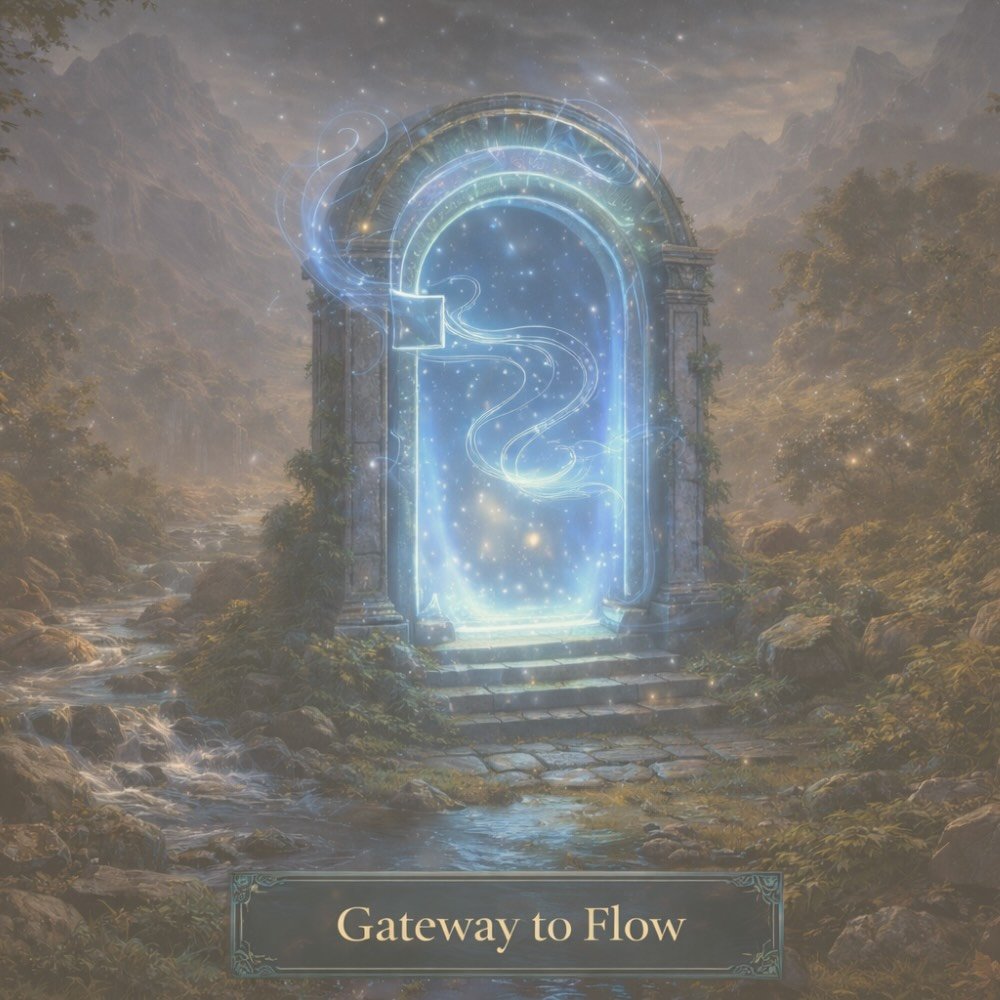
La Puerta del Flujo
(Reto 1 — IMPROV)
Tarea: → Habla durante 60 segundos (grabado para su analisis y transcripción)
Consigna: "Háblame de tu día". (en inglés por supuesto)
Tarea para realizar en clase con acompañamiento pero también en casa todas las veces que el alumno pueda.
Reglas:
- No te detengas
- No te filtras
- No buscas la perfección
Herramientas:
Si te quedas en blanco o bloqueado durante los 60 segundos puedes decir lo siguiente:
- I am thinking...
- I can't remember the word for: [ ]...
- I don't know how to say: [ ]....
- I don't know what to say...
- AS A LAST RESORT: change the subject and say anything that comes to mind in English.
Reflexión posterior:
¿Cómo te sentiste con la tarea? ¿Qué te resultó difícil?
When English is not the problem
From “I don’t know what to say” → to real expression
Some students believe they don’t speak enough English.
Others feel that their life is too “boring” — that they simply don’t have enough to talk about.
Sometimes both are true, to a certain extent.
Sometimes one is more true than the other.
But what is always true is this: You can make a little go a long way.
Because the real shift is not from “not enough” to “more”…
but from “just enough” to “plenty.”
It’s not about having more vocabulary,
more experiences, or more impressive things to say.
It’s about learning how to expand what you already have
and turn it into something meaningful.

Most people are not lacking English.
They are lacking permission to express what is already there.
The 3-Layer Expansion Method
Every idea can have 3 steps:
- WHAT → the basic idea
- DETAIL → add information
- OPINION / FEELING → make it personal
- I played with my sister. (what)
- I played with my sister in the park. (+ detail)
- I played with my sister in the park, and it was really fun because we don’t usually spend time together. (+ opinion)
→ Same life
→ Same day
→ Same “boring” content
But now it becomes decent, authentic communication.
You have included something personal and that makes it real.
You get to decide what makes it interesting!
Some people do a lot with very little and some people do very little with a lot.
If we start from the perception that we don’t have anything interesting to say, then 'English' is not the problem. The problem is not knowing how to generate content in real time.
What is actually happening?
When you try to speak, your brain is often waiting for:
✅ the correct idea
✅ the interesting idea
✅ the impressive idea
You are judging yourself and censuring yourself in real time and while you wait…
→ you stop
→ you hesitate
→ you feel blocked
The Reframe:
Instead of thinking: “I need something interesting to say”
→ Start thinking: “I create interest by HOW I say things”.
You don’t need: an exciting life, a perfect story, amazing ideas.
→ You need to learn how to build and expand simple ideas
The Four Voice Gates of the Valley of Conversation
When the traveller crosses the bridge and enters the Valley of Conversation, they do not simply begin to speak.
They are met by four gates.
Each gate presents a different challenge— not of knowledge, but of expression.
To move forward, the traveller must learn to pass through them.
The first is the Gateway to Flow (La Puerta del Flujo), where the task is simple: keep going.
No stopping, no filtering, no searching for perfection—only movement.
(We have just completed our first challenge with the Gateway to Flow. ↑)
The second is the Gateway to Truth (La Puerta de la Verdad), which asks for something real. Something unedited. Something that might usually remain unsaid.
The third is the Gate of Fun (La Puerta del Juego), where language becomes lighter—where humour, creativity, and freedom enter the voice.

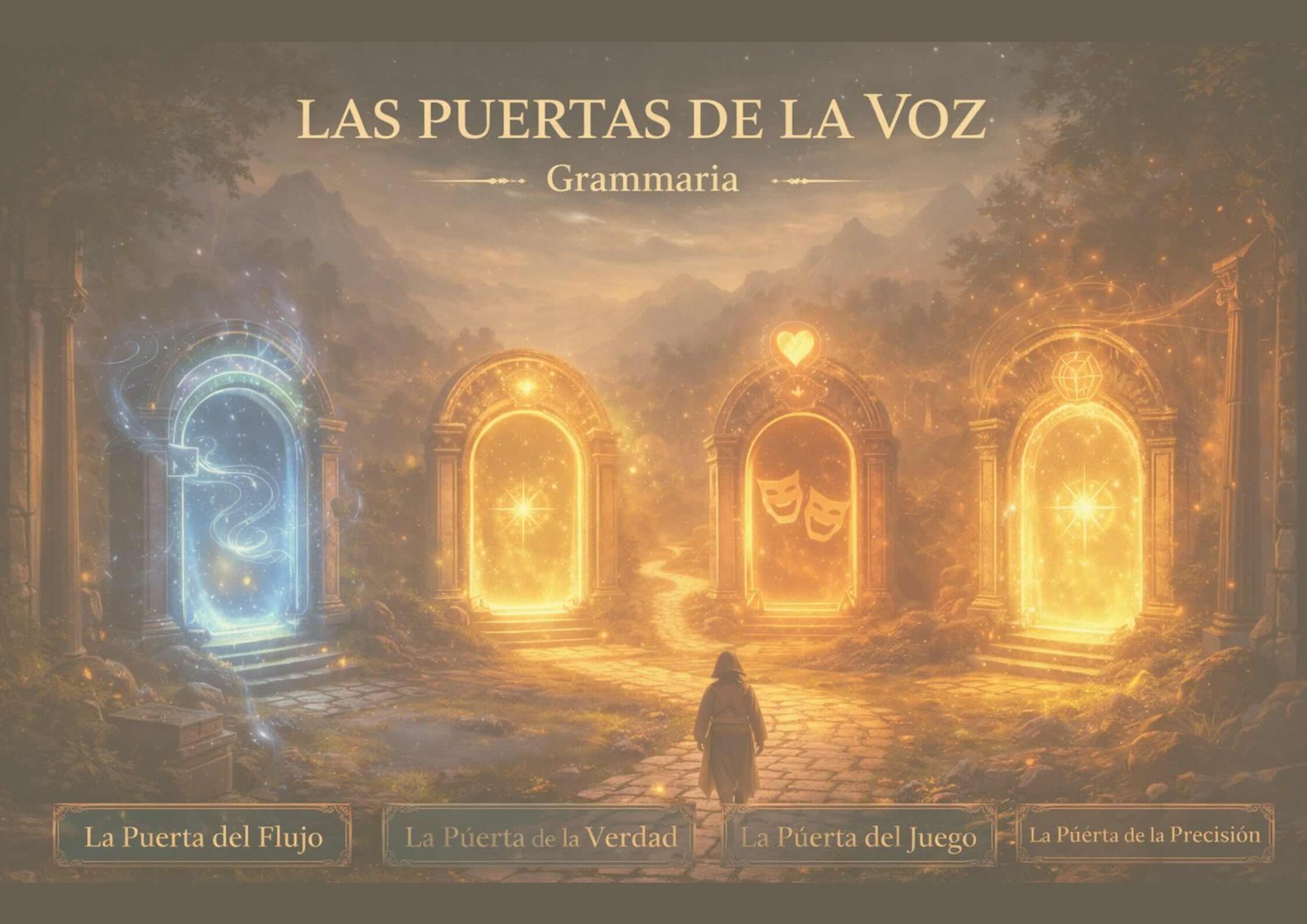
The Gateway to Precision (La Puerta de la Precisión), is not less important but must be secondary to flow, truth and play, where the traveller begins to refine, shape, and articulate with care. It is the fourth and final gate.
These gates are not crossed once, nor in a fixed order. During his time in the Valley of Conversation, the traveller will return to them again and again — each time with greater awareness, control, and freedom.
Because true conversation is not built in a straight line, but through the integration of all four:
flow, truth, play, and precision.
THE ART OF SELF-AUTHORSHIP
The core principle of this course goes beyond simply learning English.
It is based on one idea:
Language as identity in motion.
At some point, every learner faces a deeper question:
Why am I really learning English?
For some, it begins as a practical need—an exam, a qualification, an opportunity.
But over time, something more important emerges:
→ the desire to express yourself freely and fully in another language.
This course is built around that shift.
Because real progress in English does not come from memorising more content,
but from developing the ability to communicate meaningfully.

The Londinense Methodology recognises a powerful feedback loop:
→ Your English will often reflect the quality of your communication in your first language.
If your expression in Spanish is limited, hesitant, or unclear,
it will naturally carry over into English.
So rather than working only on English,
we work on communication itself.
This means:
- refining how you express ideas
- becoming more intentional with your words
- strengthening your voice across both languages
This is not about speaking more.
It is about speaking with purpose.
Because language is not neutral.
→ The way you speak shapes the way you think.
→ The way you think shapes the way you act.
→ And your actions shape your life.
In this sense, language becomes a tool for something much bigger: self-authorship.
The goal of this course is not only to help you speak English better,
but to help you use language consciously—
so that what you say aligns with who you are and who you are becoming.
Your video of Ritual 1 of the Conversation Lab in action:
Don't forget to maintain your relationship with the 4 Frikis!
Los habitantes más importantes de Grammaria son los cuatro “Frikis”. No son personajes al azar — son herramientas de aprendizaje poderosas. Cada uno representa un elemento estructural clave del inglés.
De hecho, estos cuatro elementos son tan fundamentales que, sin dominarlos de verdad, es casi imposible hablar inglés con confianza.
En el curso Essential los hemos conocido en detalle pero...
YOU MUST KEEP UP YOUR FRIENDSHIP WITH THEM.

🔁 Buenas Prácticas durante el Curso:
Consistency is more powerful than force — find a time to turn each unit into your English ritual, not a task.
La constancia es más poderosa que la fuerza — encuentra un momento para convertir cada unidad en tu ritual de inglés, no en una tarea.