The River of Ing
Well, first I want to anchor '-ing' in my English Teaching Universe: 'Grammaria'.
In Grammaria '-ing' is a river.
In Grammaria, '-ING' is not a form. It is a shapeshifting force.
It is the Energy of Continuity.
It is: “THE RIVER OF ING”
This magical river flows through all lands:
- Rootlands (Essential) - (basic meaning)
- Wanderlands (Explore) - (exploration)
- Highlands (Evolve) - (expression)
- Everlands (English for Life Club) - (gentle expansion)
- Inner Sanctum (Mentoría) - (precisión)
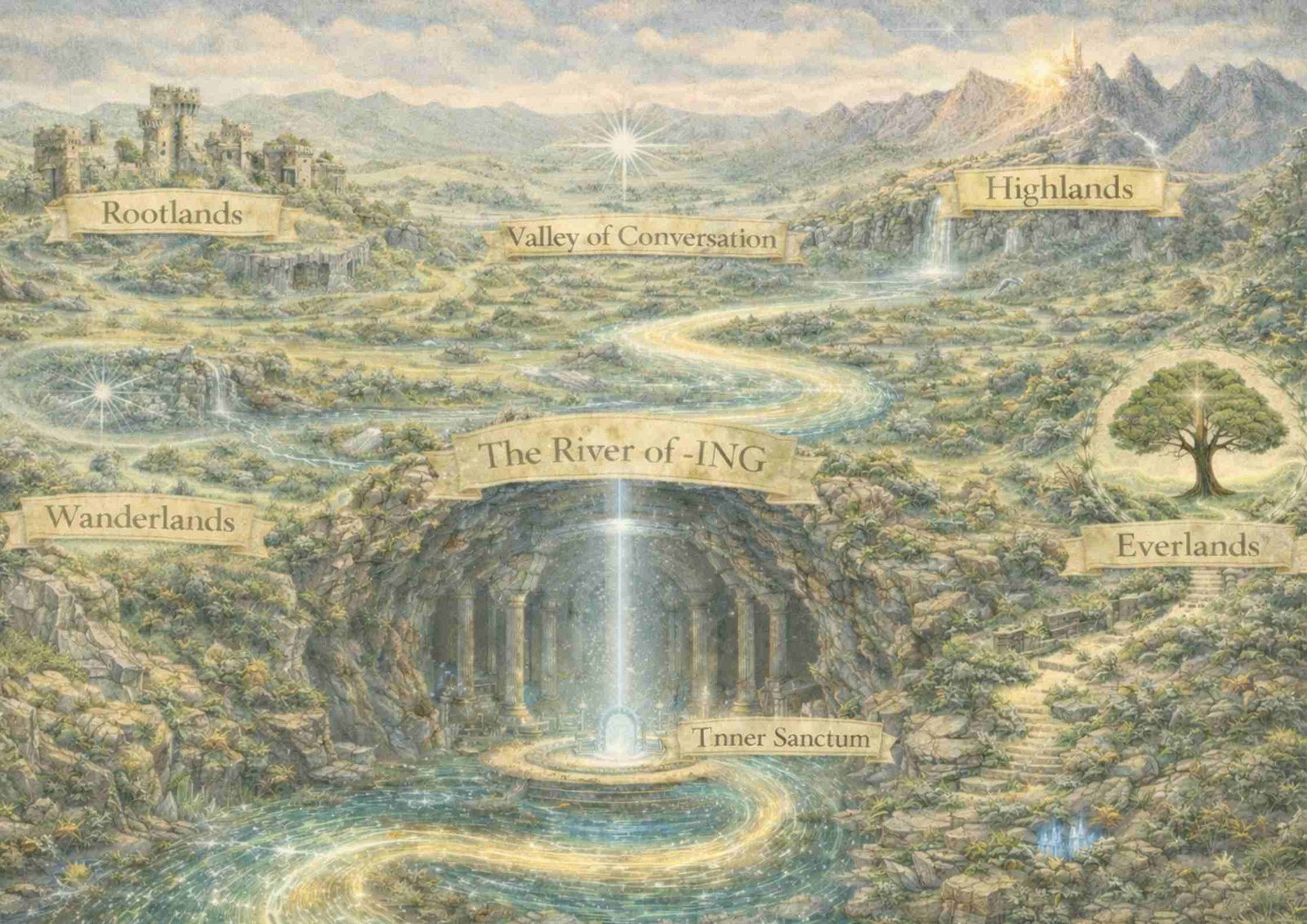
The First Encounter
When students first arrive at the river, they realise:
“This is not just a verb… this is something else.”
They discover that the River of Ing has 3 Primal Powers:
- The river can become a thing - (Swimming is good...)
- The river can become a quality - (a boring class)
- The river can become a process - ( I saw him running)
This river is a glowing liquid that changes shape.
(This is an introductory lens for contexts where the ending '-/ing' appears in English.)

The Three Forms of the River:
- It solidifies → becomes a THING
-
- Swimming, reading, learning
- It colours something → becomes a QUALITY
- boring, exciting, tiring
- It keeps flowing → becomes a PROCESS
- running, feeling, watching
In Spanish, the river mostly flows. In English, the river can also freeze… or paint the world.
Rather magically, often in English, an action doesn’t always stay an action. It can become a thing… a quality… or a process ↓
- Swimming is fun. (La natación es divertida.)
- She is wearing a swimming costume. (Ella lleva un bañador.)
- I saw her swimming lengths in the pool today. (La ví haciendo largos en la piscina hoy.)
-ING as a THING
Spanish Contrast:
- Nadar me relaja
- Leer es importante
- Disfruto aprendiendo
→ Spanish uses infinitive more often
→ English uses -ING
“Here, the action becomes a thing.”
Pattern: “If you can say ‘the act of…’ → it’s probably -ING”
'-ing' como sustantivo de actividad
La explicación gramatical que hay detrás de estos contextos no es esencial para su uso correcto.
Se resume y se incluye únicamente como referencia, pero si surge alguna dificultad a la hora de comprender estas definiciones, pueden omitirse para centrarse en la asimilación intuitiva de los patrones, que están claramente ilustrados en los ejemplos.
Aquí vemos casos donde un infinitivo en español se traduce al inglés mediante la forma -ing cuando ese infinitivo puede interpretarse como un sustantivo de actividad.
Una palabra que termina en -ing y funciona como sustantivo se llama gerundio desde el punto de vista gramatical.
Gerund = -ING actuando como sustantivo
En este uso concreto de la forma -ing, el sustantivo suele actuar como el sujeto de la frase.
-ING as a QUALITY
Identity 2: -ING as adjective (feeling/effect)
Examples:
- a boring class
- an exciting film
- a tiring day
Spanish Contrast:
- aburrido (una clase que aburre)
- emocionante (una pelí que emociona)
- cansado (un día agotador)
→ Spanish uses an adjective
→ English uses -ING
“Here, -ING describes the effect something produces.”
Important clarity:
- boring ≠ aburrido (exactly)
- boring = “causing boredom”
Adjetivos en '-ing'
Un adjetivo, por definición, no es un sustantivo, por lo que no puede ser gerundio.
En su lugar, esta forma se denomina 'participio presente' desde el punto de vista gramatical.
→ Participio presente = forma en -ING que actúa:
- como parte de un verbo (tiempo continuo), o como adjetivo.
-ING as a PROCESS
Identity 3: Introduce -ING as action in motion
Examples:
- I saw him running
- She left feeling tired
Spanish Contrast:
- Lo vi correr
- Cuando estaba cansada, se fue (/se fue, sintiendose cansada)
👉 Spanish often:
- infinitive
- full clause
👉 English compresses into -ING
“Here, the action is alive. It is happening in front of you.”
Cláusula causal o temporal con '-ing'
En estas estructuras, -ing es un participio presente que introduce una idea de tiempo, causa o condición.
En español suele traducirse con al + infinitivo o con una subordinada (porque / como si / cuando / mientras / para evitar + infinitivo)
Watch Your Video - There is a bit of psychological encouragement and an introduction to this 'ing' domination!
Summary
Objetivo: ayudarte a reconocer rápidamente patrones donde el inglés exige ‘-ing’ mientras que el español recurre al infinitivo, un adjetivo u otras estructuras.
En la fase ESSENTIAL de la Metodología Londinense, basta con vincular las terminaciones ‘‑ando / ‑iendo’ (amando, comiendo) con una forma equivalente ‘‑ing’ (loving, eating) en inglés. Es cuestión de priorizar.
En la fase EXPLORE de la metodología tenemos que “Explorar” unos contextos dónde se usa una terminación ‘-ing’ en inglés pero no el equivalente en español.
Vamos a dedicar 4 unidades para presentar 8 grandes contextos con ejemplos bilingües para cada uno. ↓
1. -ing como sustantivo de actividad
Smoking is prohibited here. – Está prohibido fumar aquí.
2. -ing después de preposición
Before leaving, lock the door. – Antes de salir, cierra la puerta.
3. Adjetivos en -ing
a boring class – una clase aburrida
4. Títulos y nombres de lugares con -ing
(Frecuentes en carteles, salas y obras.)
The Waiting Room – La sala de espera
5. Verbos de percepción + objeto + -ing
I saw him running. – Lo vi correr.
6. Cláusulas causales o temporales con -ing
(Equivalen a ‘al + infinitivo’ o subordinadas con “porque/como”.)
Knowing the answer, she smiled. – Al saber la respuesta, sonrió.
I enjoy swimming. (Disfruto de la natación.)
8. -ing como modificador de sustantivo en compuestos
Shopping bag (Bolsa de la compra)
Gramaticalmente la forma '-ing' en inglés tiene 2 categorías: como gerundio o como participio presente.
- En español, -ando / -iendo solo expresa una acción en progreso.
- Nunca funciona como sustantivo ni como adjetivo.
- En inglés, la forma -ing puede expresar una acción, un sustantivo o un adjetivo.
- Por eso, el gerundio español no es lo mismo que el ‘gerund’ inglés.
This goes beyond using the '-ing' ending for a continuous tense.
Esto va más allá de usar la terminación -ing para un tiempo continuo.
🔁 Buenas Prácticas durante el Curso:
Consistency is more powerful than force — find a time to turn each unit into your English ritual, not a task.
La constancia es más poderosa que la fuerza — encuentra un momento para convertir cada unidad en tu ritual de inglés, no en una tarea.
If you want to read in more depth about the different areas inside the 'Londinense Methodology', you can explore the website at your leisure. ↓






Don't forget to maintain your relationship with the 4 Frikis!
Los habitantes más importantes de Grammaria son los cuatro “Frikis”. No son personajes al azar — son herramientas de aprendizaje poderosas. Cada uno representa un elemento estructural clave del inglés.
De hecho, estos cuatro elementos son tan fundamentales que, sin dominarlos de verdad, es casi imposible hablar inglés con confianza.
En el curso Essential los hemos conocido en detalle pero...
YOU MUST KEEP UP YOUR FRIENDSHIP WITH THEM.