The River of Ing
In the last ritual, we anchored '-ing' in my English Teaching Universe: 'Grammaria'.
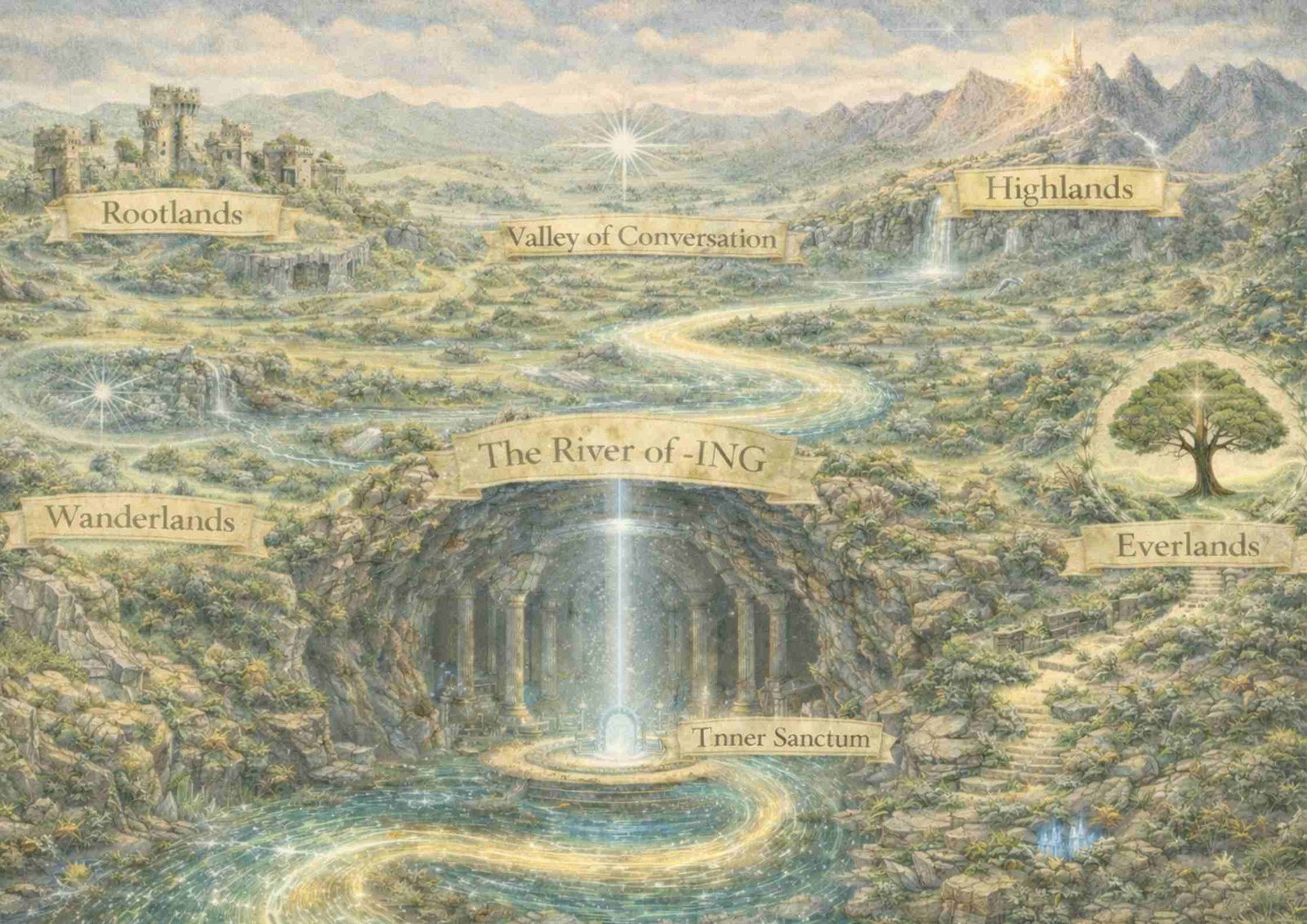
In Grammaria '-ing' is a river - not a form but a shapeshifting force that carries the Energy of Continuity.
In this ritual we revisit 'The River Ing' and we see that
“In some parts of Grammaria…
the 'River of ING' is impossible to avoid.”
“If you step there…you fall in.”
The Second Encounter
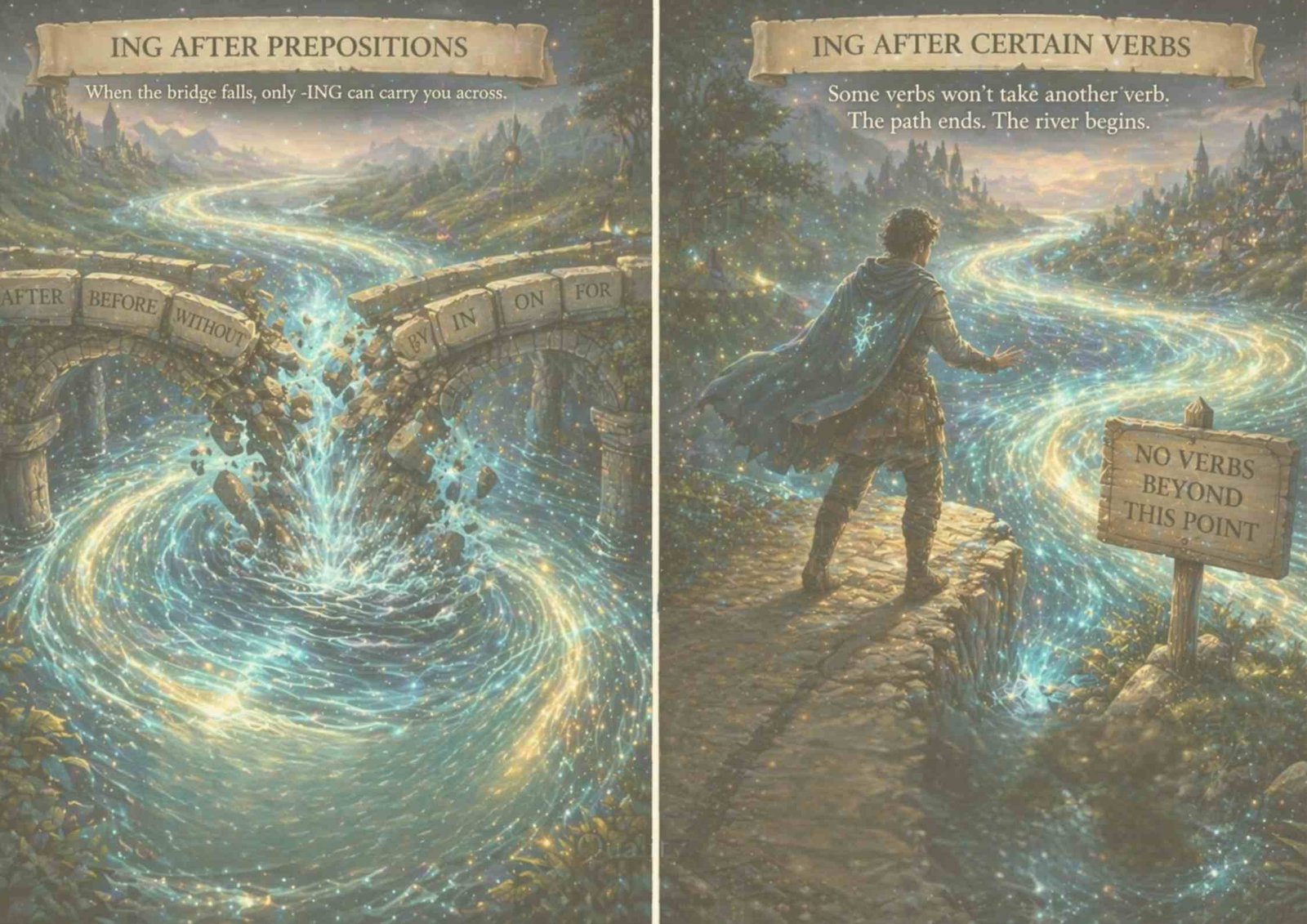
Sometimes students meet the river via
- bridges that collapse (AFTER PREPOSITIONS)
- paths that end in water (AFTER CERTAIN VERBS)
A preposition can never be followed by a verb.
So 'The River Ing' transforms the action… into a thing.
Some verbs don’t accept another verb after them.
So again… the river appears.
The second action becomes a thing.
-ING appears when English needs to treat an action like a thing.
The Bridge Collapses AFTER PREPOSITIONS
(-ING as a THING)
Preposition examples:
- after
- before
- without
- by
- for
- in
- on
Sentence examples:
- After eating, we left.
- Close the windows before leaving.
- Do it without making any noise.
You must remember that a preposition can never be followed by a verb.
So English transforms the action… into a thing.
Adding '-ING' — makes the word behave like a noun.
Spanish Contrast:
- Después de comer
- Antes de salir
→ Spanish uses 'de' + infinitive
→ English forces -ING
The path meets the river AFTER CERTAIN VERBS
Verb Examples:
- enjoy
- avoid
- consider
- suggest
- keep
- finish
- mind
Sentence Examples:
- I enjoy reading.
- She avoids talking about it.
- They considered moving.
Some verbs don’t accept another verb after them.
So again… the river appears.
The second action becomes a thing.
Spanish Contrast:
- Disfruto leer
- Evita hablar
- Consideraron mudarse.
→ Spanish = infinitive
→ English = -ING
'-ing' After a Preposition
(Grammar + Exercise)
A veces se dice que 'cualquier ‘verbo’ que vaya después de una preposición debe ir en forma -ing.'
→ Referirse a ello como ‘verbo’ es algo que se suele hacer por error.
Esta forma en -ING se comporta gramaticalmente como un sustantivo, aunque “suene” o “se sienta” verbal.
→ Desde el punto de vista sintáctico, ocupa una posición de sustantivo en la oración.
De hecho, lo correcto es decir que 'una preposición solo puede ir seguida de un sustantivo' (o de algo que funcione como tal).
→ Por eso, la forma en -ING sigue llamándose GERUND (English).
→ Recuerda: 'Gerund' = -ING actuando como sustantivo
Resumen:
- Las preposiciones no van seguidas de un verbo.
- El inglés no permite el infinitivo después de una preposición.
- En este caso, la forma en -ING está sustantivada (convertida en una “cosa”).
- Aunque semánticamente se refiera a una acción, gramaticalmente se comporta como un sustantivo.
“…the structure needs a noun...So the action transforms into -ING.”
“When English needs an '-ing' noun…the River Ing pulls you in.”
'-ing' como objeto o complemento de otro verbo
En estos ejemplos, la forma en '-ing' actúa como objeto del verbo y, a nivel conceptual, equivale a “el acto de…”.
Este es un uso nominal de la forma en '-ing' y, por tanto, un gerund (inglés).
Corresponde en español a un infinitivo.
→ Relación con “-ing como sustantivo de actividad” (Context 1)
Este uso está relacionado con la categoría “-ing como sustantivo de actividad”, pero el papel sintáctico es distinto:
→ En Swimming relaxes me, ‘swimming’ es el sujeto de la frase.
En ambos casos, el verbo en '-ing' funciona como un sustantivo, pero ocupa un lugar diferente dentro de la oración.
Watch Your Video - There is some practice of the context seen in the previous ritual...
🔁 Buenas Prácticas durante el Curso:
Consistency is more powerful than force — find a time to turn each unit into your English ritual, not a task.
La constancia es más poderosa que la fuerza — encuentra un momento para convertir cada unidad en tu ritual de inglés, no en una tarea.
If you want to read in more depth about the different areas inside the 'Londinense Methodology', you can explore the website at your leisure. ↓